Facebook
 Post
Post
 Email
Email
 Print
Print
A bit of good news: American men are going back to work.
Specifically: labor force participation is up among prime-working-age American men without college degrees.
That’s one of the key findings of Dr. Steven Camarota and Dr. Jason Richwine in their research essay for American Affairs.
The number of men in their prime working years who aren’t working has been growing for decades. This silent crisis has not been met with the policy response it deserves, partly because mass immigration papers over the problem.
Were it not for the longest and biggest sustained immigration wave in history, the managerial class would be working to bring Americans back into the economic mainstream like a NASA team working to bring a damaged shuttle back to Earth.
“Although immigration is probably not the primary cause of the problem,” Richwine wrote in an update, “importing labor from abroad is the “band-aid” that discourages our society from finding solutions.”
“If the Trump administration’s stepped-up immigration enforcement has created the incentives to get native-born men back to work, then that is certainly encouraging.”
In another encouraging sign, data from the Census and Bureau of Labor Statistics indicate that employment for Americans has increased by over 400,000.
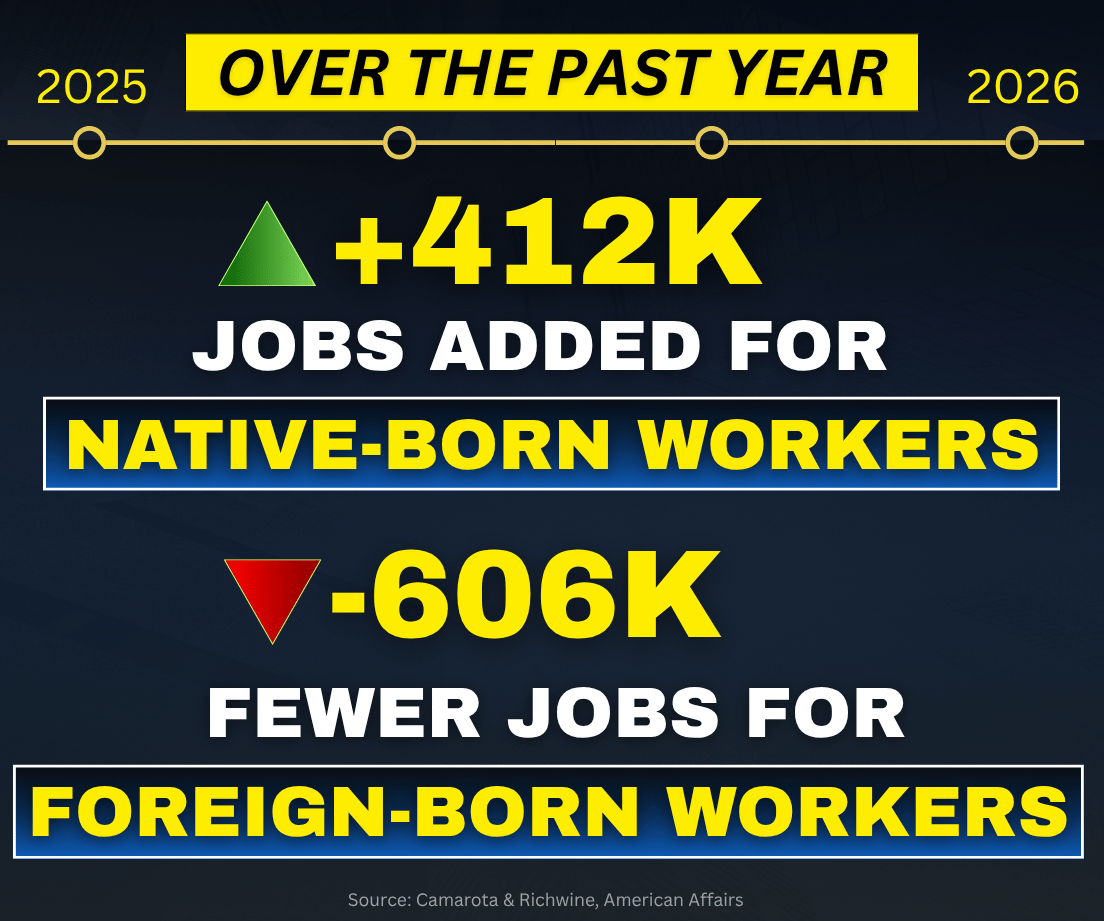
This good news should be entirely unsurprising given a decline in the illegal workforce after four years of record-setting increases. But Camarota and Richwine warn the gains are fragile. Without sustained, predictable policy, employers — and politicians — will fall right back into old habits.
Dignity of a Good Day’s Work
Back in the 1980s and 1990s, Dunkin Donuts ran a long ad campaign featuring Fred the Baker, a working man who was constantly leaving the house, day and night, to make freshly-baked donuts to satisfy his happy customers who keep coming back for more. The comedic campaign leaned into an often weary Fred declaring his catchphrase, “time to make the donuts,” round the clock.
“It isn’t easy,” the narrator declared. And yet the ad depicted Fred as a married man with his own home who enjoyed the reward of providing a superior product.
It’s popular in some circles, particularly within the minority of Americans with college degrees, to assume that most jobs like Fred’s are beneath Americans today; or that they should be. Some say these are “jobs Americans won’t do” and if they are doing them, it’s due to some failure to get a better education. In this worldview, mass immigration offers opportunities to people from around the world to fill American jobs and keep services affordable for the Americans who use them.
There are some serious problems with that approach.
If a job is truly beneath American standards, that’s a problem with the job, not Americans.
If the wages and conditions being offered are not good enough to attract any Americans, our policy shouldn’t be to shrug and hand it over to a foreign worker who is desperate enough to accept it.
The mass immigration vision ignores some practical realities:
- Americans are already doing these jobs
- U.S.-born workers make up the majority in all but six of the 500+ Census-tracked occupations
- By many measures, America already has an oversupply of highly-educated workers
- Two thirds of Americans do not have college degrees
One thing is clear from the Census and Bureau of Labor Statistics data: there is no shortage of labor in America. The challenge is to bring a class of workers that has been falling through the cracks for decades back into the mainstream.
Congress should rip off the band aid, end mass immigration, unleash American recruitment and innovation, and restore the promise of a dignified day’s work.
It’s time to make the donuts.
Not Your Members? | Create Account or Log In to manually enter your address.