Facebook
 Post
Post
 Email
Email
 Print
Print
A Family Farm Nearly Lost
The Henry family farm in Cranbury Township, New Jersey, ultimately was spared. After months of public controversy, state officials, the township, and the Henry family reached an agreement that preserved the 175-year-old, 21-acre farm and shifted a proposed affordable housing development elsewhere. But the episode exposed a larger problem. As federal immigration policy admits millions of new immigrants each decade, demand for housing continues to grow, increasing pressure to convert farmland into development. The Henry farm may have been saved, but the forces that threatened it are getting stronger.
The controversy began when Cranbury Township sought to acquire Andy Henry’s family farm by eminent domain to satisfy New Jersey’s affordable housing requirements. Henry had reportedly spent decades refusing offers of $20–30 million from developers because he wanted the property to remain a working farm. After resisting private development for more than thirty years, he instead faced the possibility that the government would take the land for housing. Although the farm was ultimately preserved, the case illustrates how even dedicated conservationists can be overtaken when policymakers focus on accommodating housing demand rather than moderating the demand itself.
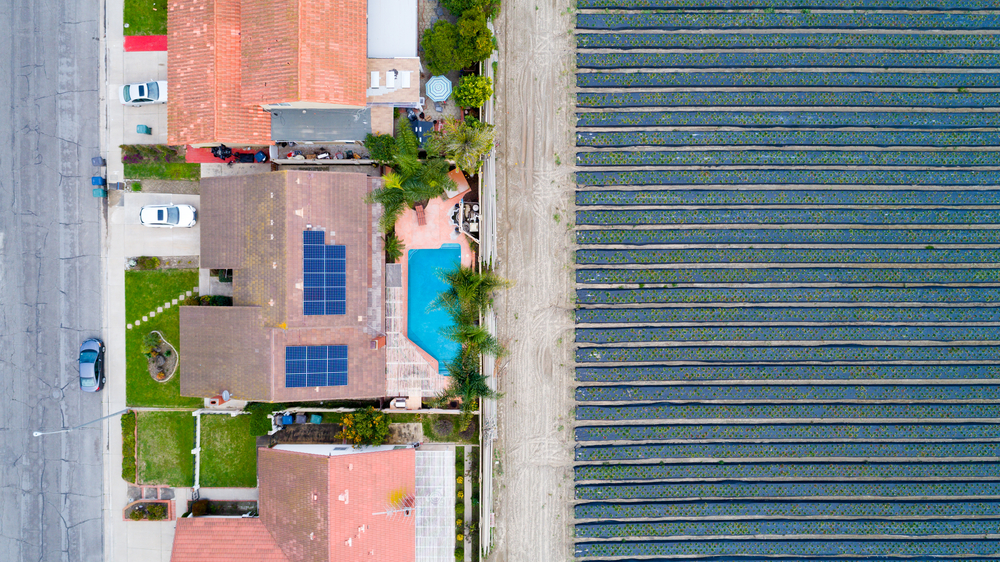
As housing demand grows, communities increasingly face difficult choices between accommodating new development and preserving productive agricultural land.
The Demand Side of the Housing Debate
Affordable housing is a legitimate concern. Rising home prices and rents have made it increasingly difficult for many Americans to buy or rent a home. Most proposed solutions, however, concentrate almost entirely on increasing housing supply through higher-density development, rezoning, or state housing mandates. What receives far less attention is the demand side of the equation. One of the principal drivers of long-term housing demand is federal immigration policy, which determines how many additional people will need housing in the years ahead.
Recent immigration has increased housing demand by adding hundreds of thousands of new households, and the Congressional Budget Office projects that much of this additional housing demand will emerge in the years ahead. As demand grows, state and local governments face increasing pressure to approve new development, expand infrastructure, and convert more open land into housing.
This is not an argument against immigrants or against affordable housing. It is an argument for recognizing that conservation policy and immigration policy are connected. If policymakers continually expand immigration-driven housing demand while focusing only on increasing housing supply, development pressure will inevitably spread onto farmland, forests, wetlands, and other open space.
How Immigration Policy Shapes Farmland Preservation
The American Farmland Trust projects that, under current trends, the United States could lose another 18.4 million acres of farmland and ranchland by 2040—an area nearly the size of South Carolina. Once farmland is developed, it is rarely returned to agriculture.
America has invested billions of dollars to preserve farmland, protect open space, and conserve wildlife habitat. Those investments remain worthwhile. But lasting conservation also requires addressing the immigration-driven demand for housing that continually places those lands at risk.
The Henry farm was saved. The next one may not be. America cannot preserve farmland indefinitely if housing demand continually outpaces the land available to accommodate it. Immigration policy is one of the few tools Congress directly controls that influences future demand for housing, infrastructure, and land. If policymakers want to preserve America’s farmland over the long term, immigration policy should become part of the strategy.
Not Your Members? | Create Account or Log In to manually enter your address.