Facebook
 Post
Post
 Email
Email
 Print
Print
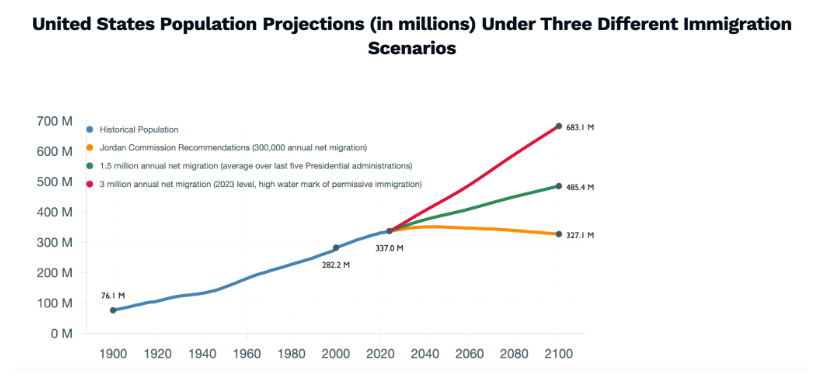
“How big do we want to be?” Mass immigration is the determining factor in the size of our country, the amount of infrastructure that must be built, resources to be used, and quality of life that we live.
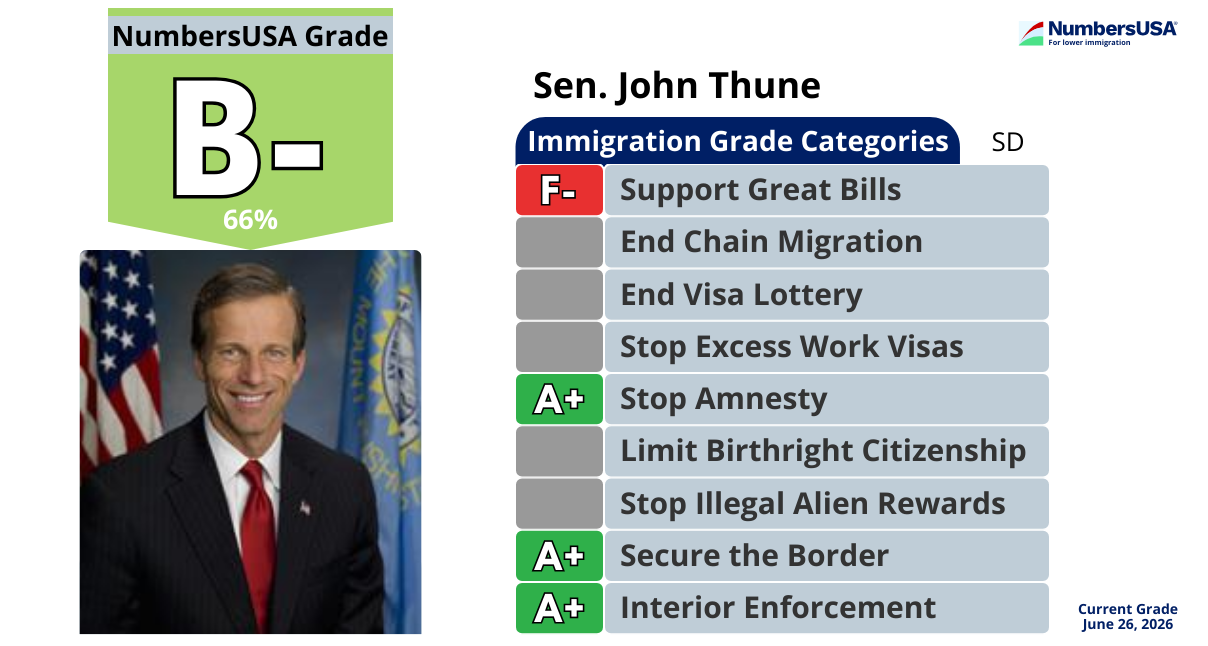
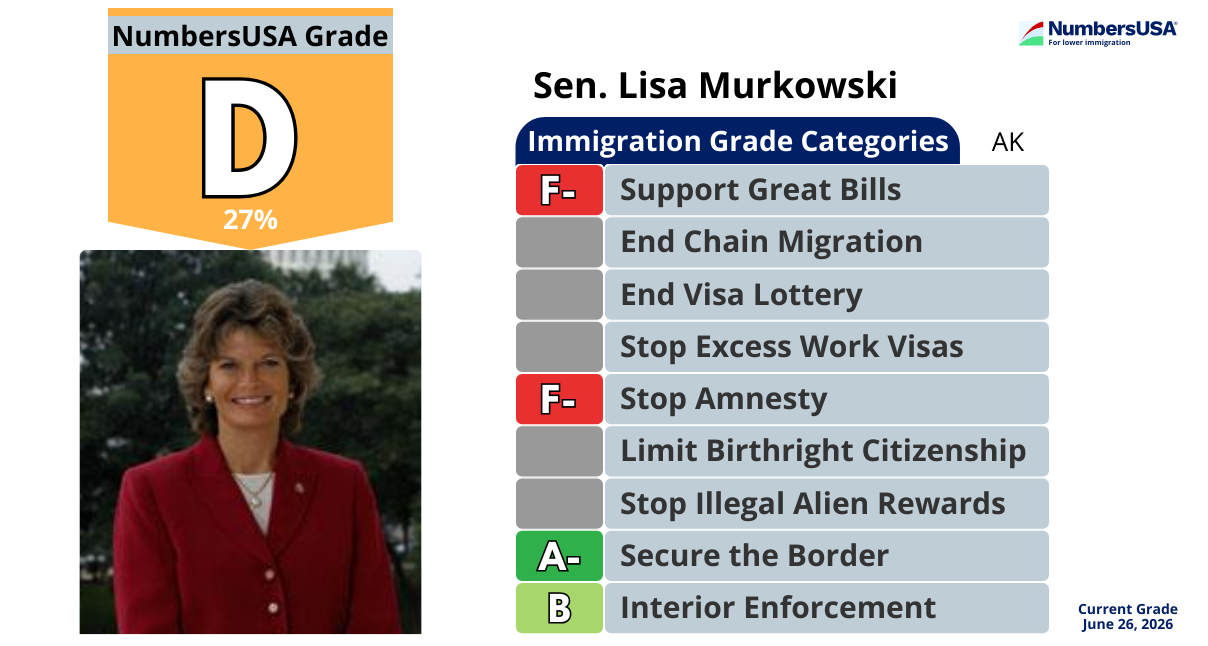
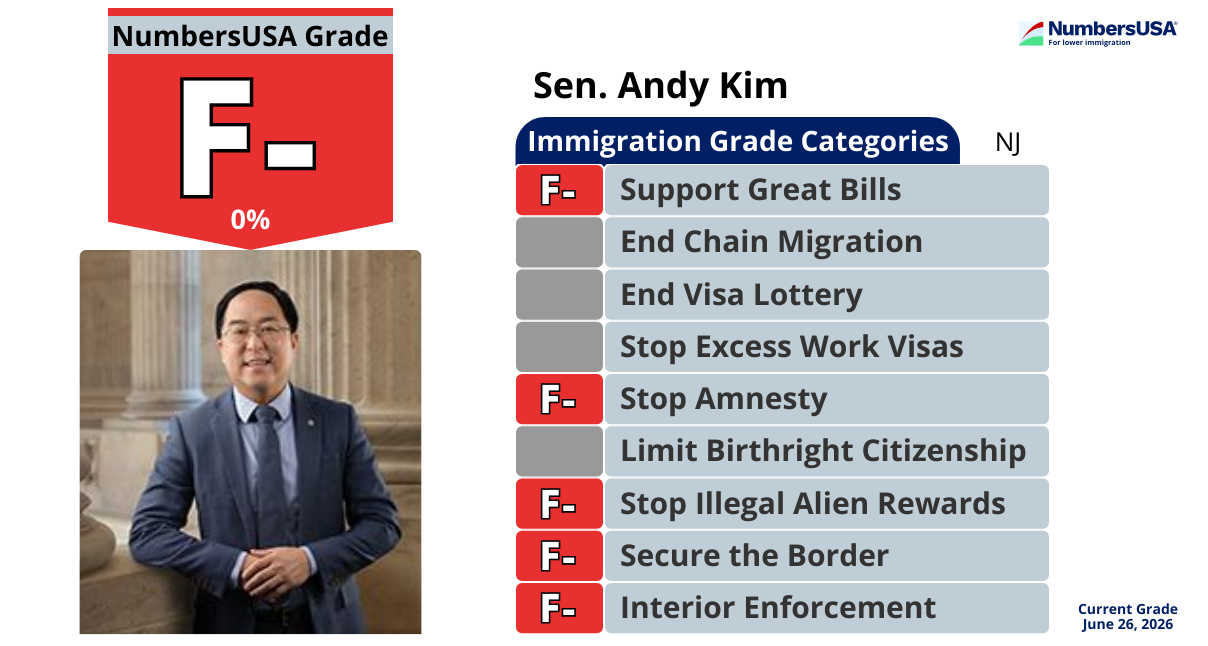
Look at the chart below and compare it to NumbersUSA’s Immigration-Reduction Grade Cards. More than half of Congress favors immigration levels close to the red line, while nearly 180 members favor something closer to the orange. The rest support policies that indicate a preference for the status quo green line.
Recent news from across the American West reminds us that almost nothing will determine the kind of country our children and grandchildren will live in than the immigration policies Congress sets today.
More People Relying on Less Water
Lake Mead, the nation’s largest reservoir, recently fell to only about 27 percent full, while Lake Powell, the second largest, is at about 22 percent of capacity. But the problem extends well beyond Mead and Powell.
Colorado’s Blue Mesa Reservoir, the state’s largest, has fallen to roughly one-quarter of capacity. Blue Mesa sits on the Gunnison River, a major tributary of the Colorado River, and has previously provided emergency water to help support Lake Powell. This year, Blue Mesa itself is so depleted that significant releases to Powell are not possible.
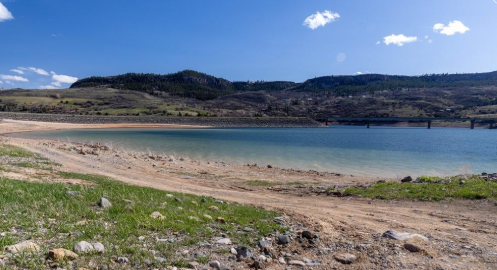
Blue Mesa Reservoir. Once #1, Colorado’s 2nd-largest body of water (as of August 2026).
Denver’s water system is also under severe stress. Its reservoirs were only 72 percent full in late August, compared with an average of 94 percent. April-through-July natural streamflow was just 22 percent of normal—the lowest in 110 years of recordkeeping. Conditions are even more dramatic in New Mexico, where Elephant Butte Reservoir has fallen to about 1.4 percent of capacity and an 82-mile section of the Middle Rio Grande has dried up.
Compounded by drought and unusually hot conditions, the West experienced extraordinarily poor snowpack and runoff this year. Immigration policy does not affect how much snow falls in the Rockies. But it does affect how many people, homes, and businesses depend on the water supplied by that snowmelt.
Arizona provides some perspective. Its population has grown from 3.7 million in 1990 to 7.6 million today—more than doubling in 35 years. Immigration has become the principal driver of U.S. population growth, and immigration policy therefore influences how much additional demand for water, housing, and infrastructure the nation must accommodate.
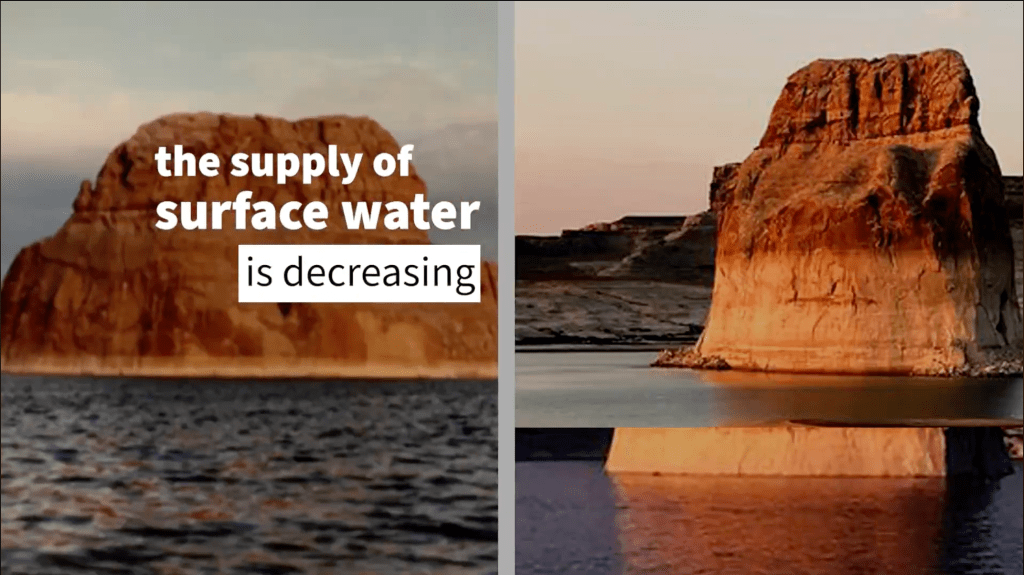
When Dams Created a Buffer Against Drought
Much of the modern West was made possible by an extraordinary era of dam building. Beginning with the Reclamation Act of 1902 and accelerating during the “Big Dam Era” of the 1930s through the 1960s, the federal government built enormous reservoirs to capture runoff, irrigate arid lands and provide dependable water for growing cities.
But the Colorado River system was built around an assumption that the river would continue providing enough water to support the uses being allocated to it. Unfortunately, its early allocations were based on measurements from 1905–1922, an unusually wet period that USGS later found had the highest long-term average river flow of the 20th century.
Still, these dams and reservoirs provided the West with enormous resiliency by storing water from wet years for dry ones. But the infrastructure also enabled population, agriculture and economic activity to grow around a water supply that ultimately proved less dependable than anticipated.
A century later, that mismatch has become increasingly difficult to manage. After years of unsuccessful negotiations among the seven Colorado River Basin states, the federal government in August imposed a new operating plan that will reduce Lower Basin deliveries to Arizona, California and Nevada by about 21 percent beginning in 2027. Nevada promptly sued.
The dispute illustrates what scarcity looks like in practice: states, cities and farms competing for shares of a river that can no longer reliably satisfy all of the demands placed upon it.
Agriculture adds another dimension. Colorado River water sustains roughly 5.5 million acres of farmland. Between 2017 and 2022, the Mountain states lost 1.8 million acres of irrigated cropland, or 14 percent, amid drought and restricted water supplies. As irrigated farmland declines, the resulting loss of food-production capacity can mean higher food prices, greater reliance on food imports, or both—an especially troubling prospect as a growing population increases food demand. Transferring scarce water from agriculture to growing cities can therefore relieve one population pressure partly by worsening another.
Wildfire and the Expanding Bull’s-Eye
A similar dynamic is playing out with wildfire.
This summer’s fires around Spokane (WA) provide a striking example. Three major fires burned roughly 10,000 acres—far less than many large Western wildfires. But because they reached developed neighborhoods, more than 900 structures were damaged or destroyed.
Spokane Emergency Management Director Sarah Nuss identified continued development in fire-prone areas as one contributor: “And we are building into the wildland urban interface.”
The wildland-urban interface, or WUI, includes places where housing and wild vegetation meet or intermingle. As development pushes farther into these landscapes, the potential target for wildfire expands.
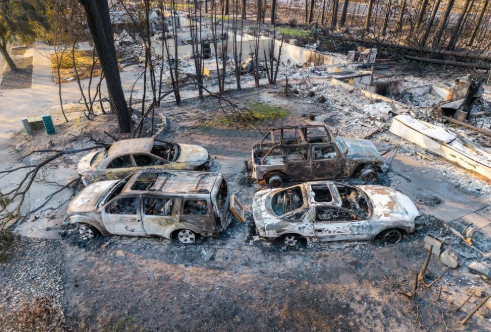
Aerial view of burned homes and charred lots, Spokane, WA (August 2026).
Research published in Science found that the number of U.S. houses located within wildfire perimeters—within the boundaries of areas that actually burned—has doubled since the 1990s. Researchers attributed 53 percent of that increase to more land being burned and 47 percent to housing growth. Increased burned area reflects several factors, including hotter and drier conditions, fuel accumulation and a long history of fire suppression. Housing growth creates a different problem: it enlarges the target.
Disaster researchers call this the “expanding bull’s-eye effect.” A natural hazard can become a larger human disaster not only because the hazard becomes more severe, but because more people and property occupy the landscape exposed to it.
And the bull’s-eye continues to expand. Spokane County (pop. 560,000) is planning to accommodate roughly 100,000 additional residents over the next 20 years. New residents create demand for housing and infrastructure, including at the metropolitan fringe where development and fire-prone landscapes can meet.
At the national level, immigration has become a major driver of population growth. By adding to that growth, high levels of immigration increase overall demand for housing and development, expanding the potential for more people and property to occupy fire-prone landscapes.
When Mitigation Becomes Harder
Conservation and mitigation work. Cities can conserve and recycle water, farmers can improve irrigation efficiency, and communities can manage fuels and construct more fire-resistant homes.
Southern Nevada provides an impressive example. Over the past 25 years, the region reduced its Colorado River consumption by about 40 percent while adding more than 800,000 residents. But confronted with further reductions, Southern Nevada Water Authority General Manager John Entsminger recently warned that “conservation has its limits.”
Wildfire mitigation faces a similar challenge. California’s new Wildland-Urban Interface Code requires increasingly fire-resistant development in vulnerable areas.
But mitigation itself eventually encounters diminishing returns. The easiest conservation gains are captured first. Additional water supplies become more difficult and expensive to develop. Every expansion of the WUI creates additional homes, roads, and communities that must be protected. As population and development press closer to environmental limits, society can find itself spending increasing amounts simply to maintain the resiliency it already has.
Losing Our Margin for Error
Water shortages and wildfire are very different environmental problems, but they share an important lesson. Environmental impacts are determined not only by changes in nature, but also by the human population exposed to those changes.
The great Western reservoirs created a huge buffer against drought. Sparsely developed landscapes similarly provided a buffer between wildfire and large concentrations of people and property. As we build into those landscapes, those buffers diminish.
Conservation, better water management, fire-resistant construction and smarter land-use policies can restore some resiliency. But mass immigration forces those measures to work increasingly hard simply to maintain the existing margin of safety.
The recent images of depleted reservoirs and burned neighborhoods therefore provide concrete evidence of what declining resiliency looks like in practice.
The more we push environmental limits, the less room we leave ourselves when nature delivers an extreme event.
Read more:
Not Your Members? | Create Account or Log In to manually enter your address.