Facebook
 Post
Post
 Email
Email
 Print
Print
A River Under Increasing Stress
Lake Mead has reached another alarming milestone. The nation’s largest reservoir recently fell to its lowest level since it was filled nearly 90 years ago. Its enormous white “bathtub ring” highlights a basic problem: more water has been allocated and is being consumed than the Colorado River can sustainably provide.
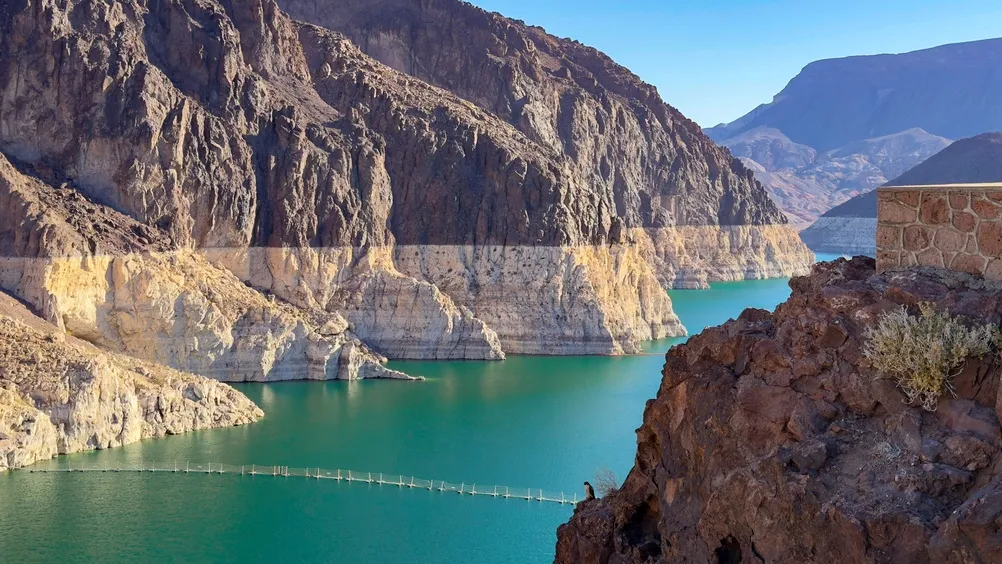
For roughly 25 years, the Colorado River Basin has endured an historic, extended drought that has reduced runoff into the river and its reservoirs. But water shortages have two sides: supply and demand. We cannot control how much snow falls in the Rocky Mountains or when the drought will end. We can, however, influence demand.
That is already happening—but almost entirely through conservation.
Las Vegas has dramatically reduced per-capita water consumption. Residents are paid to remove lawns, irrigation is restricted, and nearly all indoor water is recycled.
Agriculture faces greater sacrifices. Farmers are being paid to improve irrigation, fallow fields and reduce water consumption. But agricultural water should not be viewed simply as a reservoir waiting to be transferred to growing cities.
Farmland Is Not Expendable
The Colorado River sustains approximately 5.5 million acres of farmland. In the Lower Colorado River region, irrigation and a warm climate make year-round production possible. The region produces more than 90 percent of the nation’s cool-season vegetables during the fall, winter and spring. Fallowing productive farmland may conserve water, but it can also mean less domestic food production, lost farm income, and potentially greater reliance on imported food.
Conservation Comes With Diminishing Returns
Some savings are easily achieved: repair leaks, replace inefficient fixtures, remove ornamental lawns and modernize irrigation. Inexpensive opportunities eventually disappear, however. A lawn can be removed only once. Additional conservation becomes increasingly expensive and requires genuine sacrifice. That is where policy makers have failed to meet the challenge.
Population Belongs in the Demand Equation
If we are asking farmers to produce less, homeowners to consume less and taxpayers to spend billions to reduce demand, why aren’t we equally serious about policies that continually increase demand?
The Colorado River supplies roughly 40 million people, including some of America’s fastest-growing metropolitan areas. Every additional resident requires water. Efficiency can reduce that requirement, but cannot eliminate it.
Unlike rainfall or temperature, a pivotal component of future U.S. population growth is determined by government policy. The United States has traditionally granted lawful permanent residence to roughly one million immigrants annually, with nearly 1.3 million people receiving green cards in 2025. With nationwide births and deaths becoming close to equal, immigration has become increasingly important in determining America’s future population trajectory.
Reducing immigration would not refill Lake Mead tomorrow. Domestic migration would continue and conservation would remain essential. But slower national population growth would reduce the number of additional consumers competing for finite water supplies over the coming decades.
The benefits attributed to high immigration—additional low-income workers and economic growth—should therefore be weighed against its costs. More workers are also more consumers of limited resources.
It is fundamentally inconsistent to spend billions reducing demand in the Colorado River Basin—and potentially sacrifice productive American farmland—while federal policy continues contributing substantially to national population growth through immigration.
Conservation can postpone the reckoning, but it cannot do so indefinitely. Per-capita water consumption cannot decline forever. Yet population has continued to grow year after year, creating additional demand on an already overburdened system.
If America is serious about conserving the Colorado River, reducing immigration—and thereby slowing future population growth—should be recognized alongside conservation as a legitimate demand-management strategy.
Not Your Members? | Create Account or Log In to manually enter your address.