Facebook
 Post
Post
 Email
Email
 Print
Print
Drought Arrives Early Across the West
Across much of the American West, the summer drought season has arrived early. Snowpack—the West’s largest natural reservoir—is already gone in many places. Significant drought conditions are occurring and are expected to persist through the summer across much of the region. Montana has already invoked emergency water-sharing rules under the Yellowstone River Compact, forcing some Wyoming users to reduce withdrawals because river flows have fallen too low. Meanwhile, the headwaters that feed the Colorado, Columbia, and Missouri River systems are running well below historical averages.
The Colorado River alone supports roughly 40 million people and irrigates some of the nation’s most productive farmland. Yet the basin remains trapped in a long-running megadrought that has steadily depleted reservoirs such as Lake Mead and Lake Powell. Farmers face reduced irrigation supplies, cities are imposing conservation measures, hydropower production has become less reliable, and ecosystems are under growing stress.
Immigration Increases Demand on Finite Water Supplies
One of the most overlooked aspects of the Western water crisis is the additional demand created by continued high levels of immigration. From 2020 to 2024, immigration was the primary source of population growth across the seven Colorado River Basin states—Arizona, California, Colorado, Nevada, New Mexico, Utah, and Wyoming. Collectively, these states added more than one million residents during that period even as drought conditions worsened and water supplies became increasingly strained.
In some basin states—especially California—immigration offset domestic outmigration and accounted for virtually all net population growth during the period. Every additional household requires water for drinking, sanitation, landscaping, food production, energy generation, and economic activity. In a region already struggling with a long-running megadrought, continued immigration-driven demand for housing, water, and infrastructure is steadily shrinking the region’s buffer against drought.
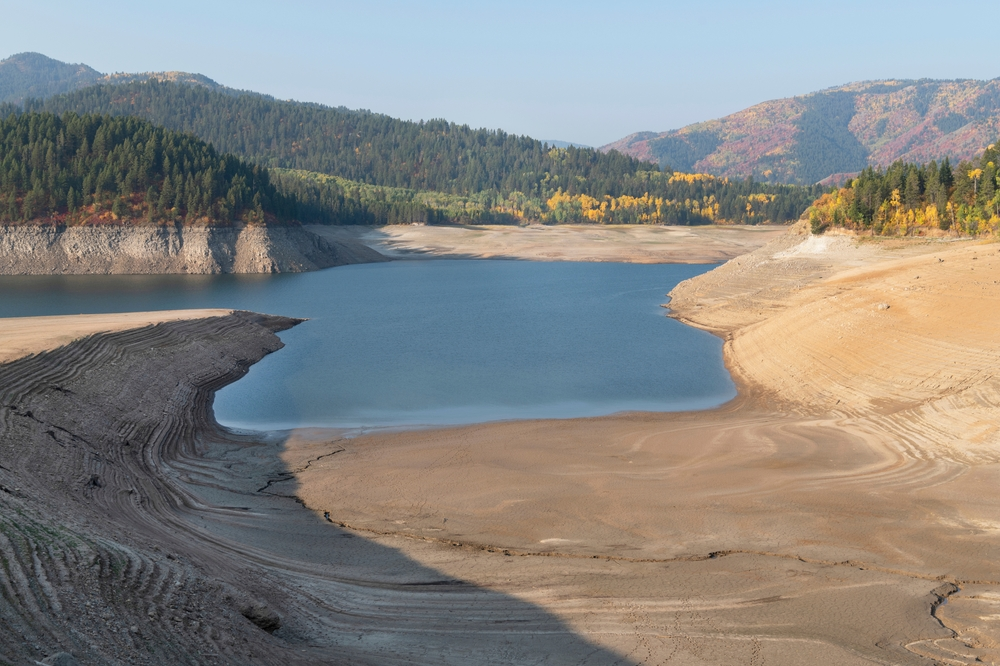
Exposed shoreline at Idaho’s Palisades Reservoir highlights the growing challenge of maintaining water supplies in an increasingly arid West. As population growth increases demand, drought leaves less margin for error.
Conservation Alone Cannot Close the Gap
Water management efforts typically focus on conservation and reuse strategies such as wastewater recycling, groundwater recharge, low-flow appliances, drip irrigation, and conservation mandates. These measures are worthwhile and should continue. But conservation can only stretch existing supplies so far. A region operating near its water limits cannot indefinitely absorb additional demand while maintaining the same level of drought resilience.
Engineering Solutions Have Limits
Technological fixes such as desalination are often presented as a solution. But desalination is expensive, energy-intensive, and can create environmental challenges of its own. Trying to engineer our way around the West’s water constraints without addressing the demand side of the equation risks creating new environmental and infrastructure burdens while reducing long-term resilience.
Wildlife and Ecosystems Are Feeling the Strain
Nature is also absorbing the consequences. Rivers and wetlands require minimum flows to sustain fish, birds, and aquatic ecosystems. As reservoirs decline and groundwater extraction intensifies, these ecosystems become increasingly vulnerable.
Warmer, shallower waterways contain less oxygen, placing stress on fish populations already coping with rising temperatures. Forests weakened by drought become more susceptible to wildfire, disease, and insect outbreaks. The West’s ability to withstand future droughts is declining as water supplies become less reliable and demand continues to grow.
Immigration Policy Is Part of Water Policy
America cannot control drought cycles or snowfall. But it can control immigration policy and the level of future demand placed on limited water supplies. Water shortages are ultimately a function of both supply and demand, and public policy has far more influence over demand than it does over precipitation.
Immigration is now the primary driver of U.S. population growth. As a result, immigration policy increasingly influences how much additional demand is placed on rivers, reservoirs, aquifers, and other water resources.
A Sustainable Future Requires Managing Demand
A sustainable water future requires more than conservation programs and engineering projects. It also requires acknowledging that continually adding new demand in an arid region with finite water supplies is unsustainable over the long term.
Reducing immigration-driven demand would help ease pressure on rivers, reservoirs, aquifers, and ecosystems while giving conservation efforts a realistic chance to succeed. The West’s long-term future will be shaped not only by water supply, but also by how much demand policymakers choose to place on that limited resource.
Find the latest updates and actions on your Action Board.
Not Your Members? | Create Account or Log In to manually enter your address.