Facebook
 Post
Post
 Email
Email
 Print
Print
Conservationists are working to recover one of America’s rarest amphibians, but habitat loss driven by continued development threatens to undermine those gains.
A Species on the Brink
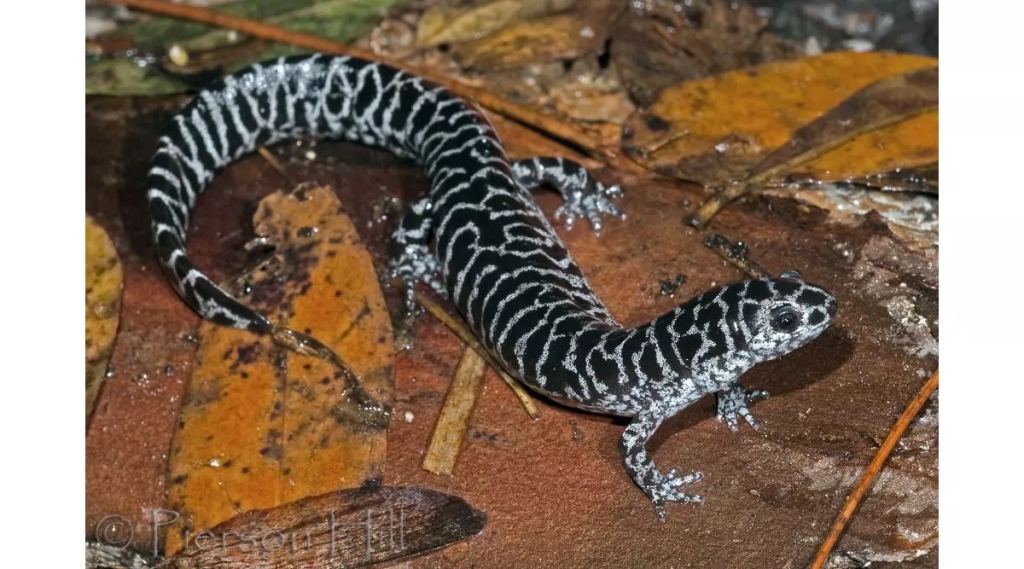
Conservationists across the Southeast are engaged in an extraordinary effort to save the frosted flatwoods salamander, an endangered salamander whose population has declined dramatically because of habitat loss and fragmentation. Wildlife agencies, zoos, universities, and nonprofit organizations are working together to breed the species in captivity, restore habitat, and reintroduce salamanders into the wild. Their dedication is admirable and may ultimately prevent the species from disappearing altogether.
Yet the salamander’s plight highlights a broader conservation challenge. By the time a species becomes critically endangered, recovery becomes enormously difficult and expensive. Captive breeding programs can buy time, but they cannot solve the underlying problem if the habitat needed for recovery continues to disappear.
Scientists can save a species’ genetic code, but if their habitat is destroyed, its only future is in an exhibit.
Conservation Can’t Outrun Development
That challenge is becoming more difficult as demand for housing, roads, utilities, and other infrastructure continues to expand across the United States. Today, immigration accounts for most U.S. population growth, and housing economists estimate it generates a demand of roughly half a million new households per year. Meeting that demand increasingly means converting forests, farmland, wetlands, and other open space into housing developments and supporting infrastructure.
While immigration policy is often discussed in economic and humanitarian terms, it also has environmental consequences. More people require more homes, roads, utility corridors, and commercial development, placing additional pressure on forests, wetlands, and other wildlife habitat.
The frosted flatwoods salamander illustrates why this matters. The species once occupied longleaf pine ecosystems across portions of Florida, Georgia, and South Carolina. Today, only a handful of populations remain. More than 95 percent of the Southeast’s original longleaf pine habitat has been lost to agriculture, development, commercial forestry, roads, and other human activities. The salamander depends upon a specialized landscape of longleaf pine forests and seasonal wetlands. Without those habitats, there is simply nowhere for recovered populations to thrive.
Habitat Loss Is the Common Thread
This pattern extends far beyond a single species. Across the country, conservationists spend millions of dollars restoring habitat, conducting research, breeding endangered animals in captivity, and managing reintroduction programs. These efforts are worthwhile, but they often struggle against the same development pressures that contributed to the decline in the first place.
The causal chain is straightforward. Immigration increases demand for housing and infrastructure. Meeting that demand often requires converting forests, wetlands, farmland, and other open space into developed land. As development expands outward, habitats become smaller, more fragmented, and less capable of supporting wildlife populations. Species ranging from migratory birds and freshwater mussels to pollinators, reptiles, and mammals face many of the same challenges.
Protecting Habitat Before It’s Too Late
The lesson is clear: conservation is most effective when habitat is protected before species become critically endangered. Once populations collapse, recovery becomes uncertain, expensive, and often takes decades. Preventing habitat loss is far easier than attempting to recreate functioning ecosystems after they have been destroyed.
The scientists and conservationists working to save the frosted flatwoods salamander deserve recognition and support. Their efforts may yet save the species from extinction. But long-term success will require more than breeding programs. It will also require addressing the immigration-driven demand for housing and infrastructure that continues to consume wildlife habitat. Otherwise, conservationists may find themselves repeatedly rescuing species from the brink while the landscapes those species need continue to disappear.
Find the latest updates and actions on your Action Board.
Not Your Members? | Create Account or Log In to manually enter your address.