Facebook
 Post
Post
 Email
Email
 Print
Print
A Century-Old Promise Still Unfulfilled
More than a century after the U.S. Supreme Court recognized that Native American tribes possess some of the oldest and strongest water rights in the West, thousands of families in northeastern Arizona still live without running water. According to recent reporting by NPR and KJZZ-ProPublica, more than 10,000 homes across the Navajo Nation, the Hopi Reservation, and San Juan Southern Paiute communities continue to rely on hauling water for drinking, cooking, bathing, and sanitation.
At the same time, metropolitan Phoenix continues to grow rapidly, increasing demand for the already overallocated Colorado River. That growth has been driven in significant part by international migration, which accounted for the largest share of Maricopa County’s population growth between 2024 and 2025—a pattern reflected across the Phoenix metropolitan area.
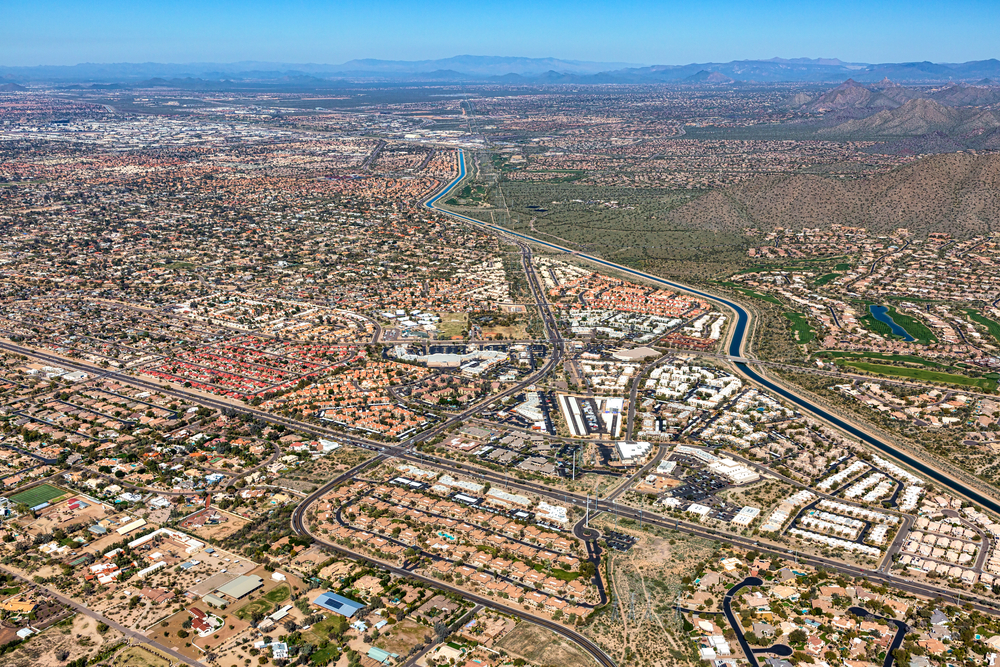
The Central Arizona Project Canal carries Colorado River water through metropolitan Phoenix, where continued residential growth is increasing demand on an already overallocated river system.
Keeping a Promise Gets Harder
A proposed federal settlement would help finance the infrastructure needed to bring running water to tribal communities. The settlement would also authorize the Navajo, Hopi, and San Juan Southern Paiute tribes to lease a portion of their Colorado River water to downstream users. Colorado, Utah, New Mexico, and Wyoming oppose that provision, arguing it could establish a precedent for additional transfers of Colorado River water to their rapidly growing metropolitan areas.
The deeper conflict is not simply over tribal water rights. It is between a fixed, already-overallocated river and steadily increasing demand for its water. That raises an uncomfortable question: Should scarce Colorado River water be used to meet the increased water demands created by mass immigration, or to finally deliver running water to Native American families whose legal water rights have gone unfulfilled for generations?
A Question of Fairness
The situation raises a fundamental issue of fairness. Tribal communities have waited generations for the infrastructure needed to use water that has long been legally promised to them, while fast-growing cities continue seeking additional Colorado River water to accommodate continued population growth. Families still haul water in tanks and buckets while policymakers struggle to divide a river that can no longer satisfy every competing claim.
Immigration is not the sole cause of the Colorado River’s problems. Prolonged drought, decades of over-allocation, agricultural demand, and inefficient water use have all contributed to today’s shortages. But population growth magnifies each of those challenges by increasing demand for an already limited resource. If immigration-driven population growth were lower, municipal demand for Colorado River water would also be lower. That would not eliminate the basin’s water challenges, but it would reduce competition for a finite resource and make it easier to fulfill long-delayed commitments to Native American communities.
Conservation Requires Managing Demand
The Colorado River illustrates a broader principle of sustainability. Conservation investments, infrastructure improvements, and better water management remain essential. But lasting success also requires addressing the demand side of the equation. Because immigration policy is one of the few tools Congress directly controls that influences future population growth, it should also be recognized as part of America’s long-term Colorado River strategy.
Not Your Members? | Create Account or Log In to manually enter your address.