Facebook
 Post
Post
 Email
Email
 Print
Print
A Growing Environmental Challenge
Although it has been shrinking for decades, the Great Salt Lake is one of the West’s most important environmental treasures. The lake supports millions of migratory birds and contributes billions of dollars to Utah’s economy. Another consequence of the lake’s decline is that as more of the lakebed becomes exposed, windblown dust from the dry lakebed poses growing risks to air quality and public health along the Wasatch Front.
Utah has committed more than $1 billion toward conservation programs, water leasing initiatives, and voluntary water markets designed to return more water to the lake. But despite these efforts, the state is still losing ground. Conservation programs are attempting to increase inflows while growing demand continues to move in the opposite direction. But immigration-driven population growth is making it increasingly difficult for conservation gains to keep pace with rising demand for housing, infrastructure, and water.
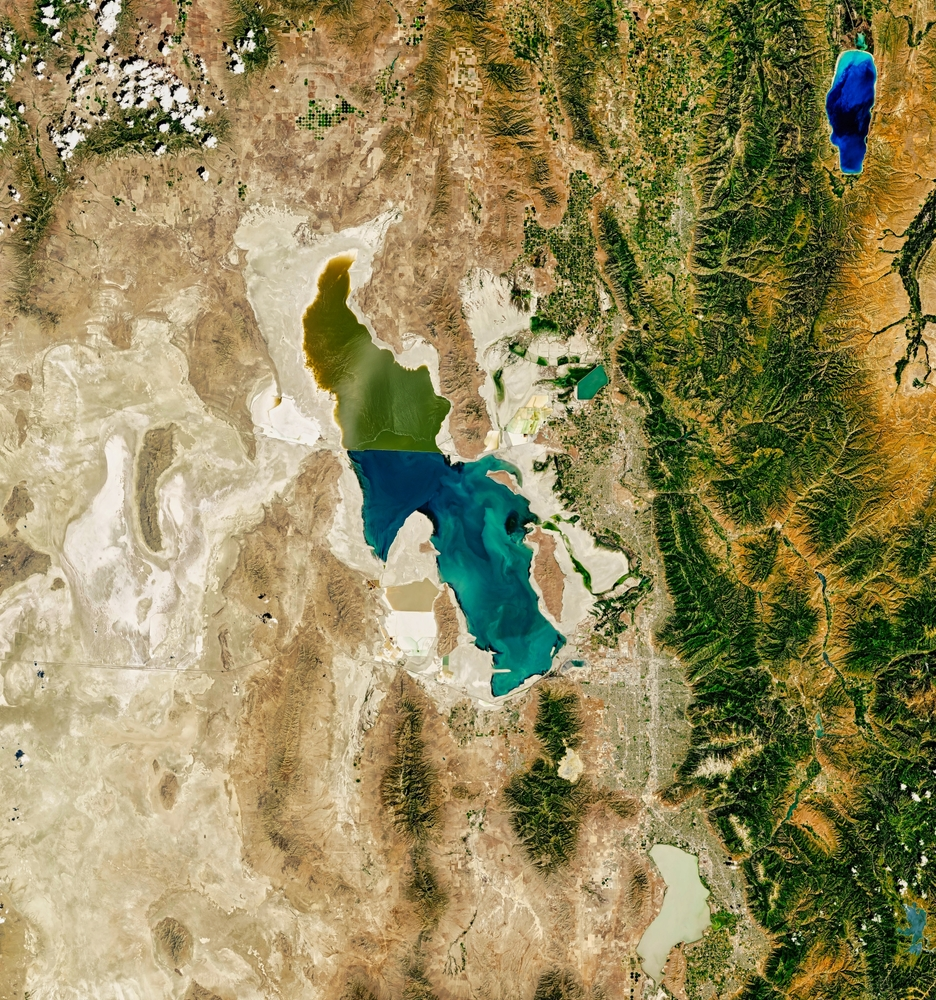
The Great “Shrinking” Lake. In summer 2022, water levels in the Great Salt Lake dropped to new record lows.
Conservation Can’t Keep Up
The Great Salt Lake needs roughly 800,000 additional acre-feet of water annually to stabilize. Last year, state programs secured only about 163,000 acre-feet. While conservation efforts have produced measurable gains, they remain far short of what is needed. At the same time, new demands for water continue to emerge. Data centers and residential development continue expanding across the Wasatch Front, bringing additional demands for water, energy, roads, utilities, schools, and businesses.
The challenge facing Utah is not simply one of water management. It is also one of continually rising demand on a finite water supply.
Water conservation policies focus on efficiency through improved irrigation, drought-resistant landscaping, and water-saving technologies that help stretch limited supplies further. However, efficiency gains can be overwhelmed when total demand continues to rise.
The Demand Side of the Equation
As housing, infrastructure, and water demand expand, more water is diverted for human use and less reaches the lake. The Wasatch Front—Utah’s primary growth corridor stretching from Ogden through Salt Lake City to Provo—is home to roughly 80% of the state’s population and lies within the watershed that feeds the Great Salt Lake. Utah added roughly 235,000 residents between 2020 and 2024, while international migration became an increasingly important source of the state’s growth. In 2024, net international migration added more than 33,000 residents.
The shrinking Great Salt Lake illustrates a broader challenge confronting many Western states: conservation gains are often offset by the very development pressures that continued growth generates. Water savings that might otherwise help restore ecosystems are instead absorbed by additional housing, commercial development, and infrastructure expansion.
A Race Against Rising Demand
Utah’s billion-dollar effort demonstrates both the promise and the limitations of conservation policy. Returning water to the Great Salt Lake is a worthwhile goal, and voluntary water markets offer a potentially effective tool. Yet even the most innovative conservation programs face an uphill battle if immigration-driven demand for housing, infrastructure, and water continues to expand.
The long-term future of the Great Salt Lake will depend not only on how efficiently Utah uses water, but also on how much demand the state chooses to place on a finite resource. Conservation can slow the decline, and technology can improve efficiency. But neither can fully compensate for the additional demand created by continual residential, commercial, and infrastructure expansion. As lake levels fall, the consequences extend beyond water supplies and wildlife habitat to include growing air-quality concerns from dust blowing off the exposed lakebed.
The Limits of Conservation
The Great Salt Lake demonstrates a simple reality: conservation cannot permanently succeed if every gallon saved is offset by new demand. Protecting the West’s water future requires not only using water more efficiently, but also moderating the immigration-driven demand that continues to strain finite supplies.
Find the latest updates and actions on your Action Board.
Not Your Members? | Create Account or Log In to manually enter your address.