Facebook
 Post
Post
 Email
Email
 Print
Print
California’s experience shows how sustained high immigration, by fueling population growth, can intensify development pressures on farmland, natural habitat, housing, and neighboring states.
About twenty-five years ago, NumbersUSA published a study with a warning about California’s future.
In its 2000 report, Sprawl in California: A Report on Quantifying the Role of the State’s Population Boom, Leon Kolankiewicz and Roy Beck examined what soaring population growth was doing to California. Los Angeles offered a particularly revealing case. From 1970 to 1990, the region became about 9% denser. Despite this apparent success of “smart growth” policies, development had still sprawled across another 394 square miles as it added 3.1 million residents.
The authors warned about another consequence of relentless population growth: Californians themselves might eventually tire of the congestion, high housing costs and declining quality of life and leave for “greener pastures” in less crowded Western states.
The prediction proved to be on target. A new NumbersUSA report, Paving Paradise: 50 Years of Population Growth in California (2026), looks back at what happened during those decades.
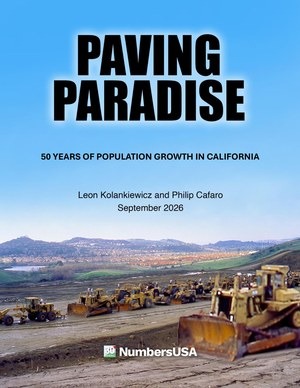
Over the past half-century, California went from a destination state for Americans to one they are leaving. Between 2010 and 2024 alone, nearly 10 million people left California for other states (negative net domestic migration was offset by international migration). The report characterizes greater affordability and improved quality of life as important motivations for this exodus. And in a 2026 survey commissioned by NumbersUSA, 75% of California voters said they either knew someone who had left because of housing costs, traffic or overcrowding, or had considered leaving themselves.
Thousands of Square Miles Paved Over
The findings from the Paving Paradise report should concern not only Californians but anyone intent on protecting the environmental future of the American West. California’s population grew from about 20 million in 1970 to 39.5 million in 2020—essentially doubling in 50 years. This rapid population growth drove widespread development.
Between 1982 and 2022, California converted 3,741 square miles—almost 2.4 million acres—of farmland and natural habitat into housing, commercial development, roads and other developed uses. That is an area nearly as large as Rhode Island and Delaware combined.
NumbersUSA then asked the crucial question: How much of this sprawl resulted from Californians consuming more land per person—for example, through larger homes and lots—and how much resulted simply from having more people?
Its analysis attributes 91% of the land conversion to population growth and only 9% to increased per-capita land consumption.
That finding challenges the simplistic assumption that better planning and higher density can accommodate perpetual population growth without sacrificing open space. Although California tried smart growth extensively, these efforts did not prevent millions of acres of farmland and wildlife habitat from disappearing.
“There is an important lesson here: when populations grow, sprawl almost always occurs. Even the best smart growth strategies typically only slow sprawl in the face of sustained population growth.” — Paving Paradise, ch. 2.7
Higher-density development can reduce the amount of land consumed by each additional resident. But it cannot eliminate the land requirements of adding millions more people.
Paving Some of America’s Best Farmland
One of the greatest losses has occurred in California’s agricultural regions.
The Central Valley is one of the world’s great agricultural landscapes. Stretching roughly 450 miles through the center of California, it produces an extraordinary quantity and variety of food while also containing the state’s largest groundwater aquifer.
Yet cities such as Sacramento, Fresno, and Bakersfield have expanded outward into agricultural landscapes as California’s population has grown. Between 1982 and 2022, developed land increased by about 142 square miles in Fresno County, 126 square miles in Sacramento County and 264 square miles in Kern County, where Bakersfield is located. Fresno County’s population increased 88% during the same period, while Kern County’s more than doubled.
The loss of agricultural land extends beyond those metropolitan areas. In Imperial County, another premier agricultural region, cropland fell from about 422,000 acres in 1982 to 273,000 acres in 2022—a 35% decline. Developed land more than tripled while the county’s population nearly doubled.
This matters far beyond California. The Imperial Valley alone supplies roughly two-thirds of U.S. vegetables during the winter months.
As irrigated farmland declines, the resulting loss of food-production capacity can put upward pressure on food prices and/or create a growing dependency on food imports. And once prime farmland disappears beneath subdivisions, warehouses and pavement, it is essentially gone forever.
Californians Know Something Is Wrong
To gauge Californians’ concerns about growth, NumbersUSA and Noble Predictive Insights conducted a randomized survey of 1,030 likely California voters in August 2026, weighted to reflect the state’s registered-voter population.
Eighty-one percent expressed concern about sprawl. Eighty percent were worried about future water supplies. Seventy-eight percent were concerned about growing commute times. And 93% said protecting California’s remaining farmland, forests, wetlands and open spaces from further development was important.
Most tellingly, when asked what they wanted to happen to California’s population, 57% preferred the population to stay the same or grow smaller. And only 11% preferred a return to rapid growth..
In effect, the survey tells Californians: You’re not imagining the impacts of growth. The traffic, disappearing open space, housing pressure and competition for water are measurable consequences of accommodating millions of additional residents.
California Exports Its Growth Pressures
California’s population growth has recently slowed dramatically. But an important reason is that so many Californians continue to leave for other states.
From 2010 through 2023 alone, California experienced a net domestic outflow of nearly 2.3 million residents, averaging about 174,000 per year. Many headed for Oregon, Nevada, Arizona, Colorado, Texas, Idaho and other states offering cheaper housing and, at least initially, less congestion.
This creates what might be called a secondary migration effect.
Continued population growth helps drive up housing costs and congestion in California. Californians who can no longer afford the state—or no longer want its crowded conditions—move elsewhere. Their arrival then adds housing demand, traffic, water consumption and development pressure to their new communities.
In other words, California’s growth problem does not necessarily disappear when a Californian crosses the state line. Rather the challenges simply spread as part of a broader “Californication” of the rest of the country.
That is particularly consequential in the arid West, where fast-growing communities in Arizona, Nevada, Colorado and other states already face water constraints, loss of open space, and rising housing costs.
California Tried Almost Everything—Except Limiting Growth
Perhaps the most important lesson from Paving Paradise is that despite its extensive conservation efforts, California failed to prevent population growth from consuming vast areas of farmland and natural habitat.
The state embraced growth-management programs, conservation easements, higher-density development, stronger pollution controls, water-efficiency mandates, low-flow fixtures, xeriscaping, improved irrigation, mass transit, renewable energy and some of America’s strongest environmental regulations. But California kept adding people.
That meant many environmental improvements had to offset additional demand before they could produce actual environmental gains. More efficient water use had to serve more residents. Denser housing still required additional development. New transportation capacity faced additional travelers. Protected habitat competed with expanding metropolitan areas.
California’s experience demonstrates that efficiency and conservation cannot indefinitely substitute for reducing population growth.
And that brings the issue back to federal policy.
California cannot control national immigration levels. Neither can Arizona, Colorado, Nevada or any other state struggling to accommodate accelerating demand for housing, land, water, food, and energy. But Congress can.
With American fertility below replacement level, immigration policy is now the principal policy lever determining whether the United States adds tens of millions more residents over coming decades. The report notes that net international migration already accounted for 84% of U.S. population growth between 2023 and 2024.
Immigration policy will influence future population growth and, in turn, how much additional demand is placed on finite resources like the Colorado River and the Central Valley’s farmland.
California spent half a century demonstrating what happens when population growth continually outruns environmental gains. The results are in—the rest of America can learn from California’s experience.
Not Your Members? | Create Account or Log In to manually enter your address.