Facebook
 Post
Post
 Email
Email
 Print
Print
Some lessons, even the most painful ones, take time to fully absorb. That doesn’t excuse further delay.
The House Intelligence Committee’s bipartisan Review of the 9/11 Commission Report laments that “the U.S. has not fully implemented a biometric exit screening system at any point of entry category,” although some progress has been made.
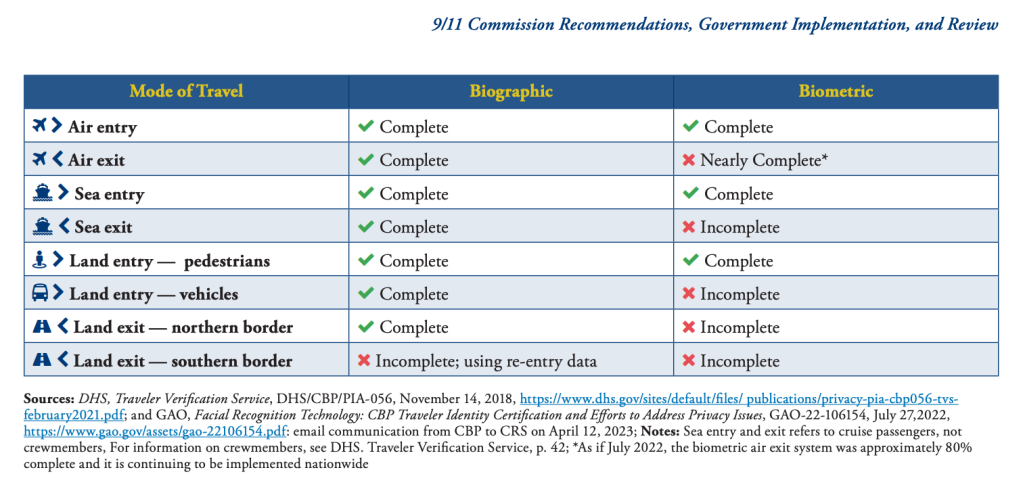
A fully functioning biometric screening system was a key recommendation of the 9/11 Commission in 2004. The European Union started phasing in its biometric entry/exit system last October.
The 2026 Intelligence Committee’s report says it is of “utmost importance” to finish the job so the United States can reliably confirm when visitors leave. Let’s tell our employees in Congress that we want this wrapped up before the 30th anniversary. Visit the Action Board.
Economic Security Is National Security
Over 400,000 people overstayed their visas in FY2024, the most recent year for which we have data. Most overstays arrive on short-term travel or business visas, while foreign students have the highest overstay rate. More than 850,000 people overstayed their visas in FY2022.
Overstays often exploit the lack of mandatory E-Verify to find illegal employment. Some remain in the U.S. illegally long enough to have a child who is automatically granted U.S. citizenship. If they stay longer still, their U.S.-born child can sponsor them for legal permanent residence and start a chain of extended-family migration.
Most visa overstayers are economic opportunists. They aren’t nefarious actors seeking to do America or Americans harm. But overstaying a visa is not a harmless act. It subverts our immigration system, dilutes democracy, and diminishes economic opportunities for citizens and legal immigrants. Furthermore, when we fail to address the broader overstay problem, we leave ourselves vulnerable to the truly bad actors.
When we enforce immigration limits to prioritize American workers, we enhance our national security as well.
Mass Immigration and Inequality Go Hand In Hand
By some measures, it has never been less rewarding to be an American worker. The share of economic output that goes to American workers has fallen to a record low, while stock prices remain near all-time highs.
Immigration policy can’t be held entirely responsible for the inequality gap, but it is a major factor. As the Nobel Prize-winning economist Sir Angus Deaton has acknowledged, many economists have trouble admitting that the law of supply and demand applies to immigration, but history is on the side of basic economics.

High levels of immigration and high levels of inequality go hand in hand. Immigration increases the supply of labor, which suppresses the bargaining power and wages of workers in affected occupations while increasing the returns to employers and investors.
A generous but moderated immigration system would help restore the American dream. There is some evidence of it working even now.
Theo Francis and Ray A. Smith of The Wall Street Journal reported this week that unemployment for young Americans without college degrees has improved, especially for those in skilled trades, “as older generations retire and immigration drops.”
Recent college graduates are still more likely to be in the labor force and employed than their non-college counterparts, but their economic outlooks have recently dimmed. Only twice in the past two decades have young college-educated workers experienced higher unemployment rates: during the pandemic and the 2007-09 recession.
In light of these trends, we should finish the job on biometric exit. We should stop ignoring illegal hiring. We should stop issuing more than a million permanent work permits every year. And we should stop running guest worker programs that displace qualified Americans with low-cost, captive foreign labor.
In Other News
- The House of Representatives has just four days scheduled in Washington, D.C. before the election.
- The bipartisan group seeking permanent work permits for over 4 million illegal immigrants did not gain any new signatures for its discharge petition this week. They remain one vote short of forcing a vote. Hold the line!
This Week In Immigration History
September 9, 1994: The Clinton Administration agrees to allow at least 20,000 Cubans to enter annually through a lottery in exchange for Cuba’s promise to stop future illegal attempts at entry by sea. The U.S. would avoid another Mariel boatlift; Fidel Castro would get a safety valve to move tens of thousands of disaffected Cubans off the island every year.
President Clinton used his “parole” authority to reach the quota. Parole is supposed to be used on a case-by-case basis under special circumstances but Clinton applied it categorically to get around immigration limits set in the Immigration and Nationality Act. President George W. Bush later institutionalized the program.
The Biden Administration abused the same parole authority to release over a million inadmissible aliens into the U.S. during the 2021-2025 border crisis.
The House Judiciary Committee marked up the border bill to end parole abuse in July. Time is running out for leadership to put it to a full vote.
NumbersUSA In The News
Sen. Jim Banks republished Joe Jenkins’ commentary on the Wall Street Journal report, which makes the case for ending Optional Practical Training through Banks’ American Tech Workforce Act (S. 2821) and Rep. Paul Gosar’s H.R. 2315.
Rep. Troy Downing featured Mike Hough’s endorsement of the No HUD Funding for Sanctuary Cities Act (H.R. 10222): “Sanctuary jurisdictions should not be rewarded with federal housing dollars while refusing to cooperate with federal immigration law.”
The Bill Martinez Show: I discussed the latest BLS numbers and what immigration policy can do to encourage domestic hiring. (55:40–1:07:38)
Dana With The Data: Andre Barnes discussed immigration policy’s historic impact on Los Angeles.
ICYMI
NumbersUSA advocates have added close to 700 public comments on the proposed H-1B fee rule since yesterday. Public comments can be submitted through Sep 24, 2026.
Not Your Members? | Create Account or Log In to manually enter your address.