Facebook
 Post
Post
 Email
Email
 Print
Print
Why America’s conservation strategy must address both supply and demand.
A Park Overwhelmed
Anyone who has visited Yosemite National Park understands why millions of Americans dream of returning. Towering granite cliffs, ancient sequoias, waterfalls, and spectacular mountain scenery make it one of America’s most treasured landscapes. But this summer, many visitors found something else waiting for them: traffic jams.
According to The New York Times, Yosemite is experiencing some of its worst congestion in years after the National Park Service discontinued its summer reservation system. Visitors have encountered hours-long backups at park entrances, overflowing parking lots, packed shuttle buses, and popular destinations closing because they reached capacity. During Memorial Day weekend, local reports described the scene as “chaos,” with vehicles spilling onto fragile meadows and driving off established roads. Similar reservation systems have also been discontinued this year at Arches National Park and Glacier National Park.
The debate has focused on whether reservation systems are the right solution. Critics argue they unnecessarily limit access to public lands, while supporters contend they are necessary to protect park resources and improve the visitor experience.
Both sides raise legitimate concerns.
But both overlook the more fundamental issue.
Reservation systems attempt to manage growing demand. They do not reduce it.
A Fixed Resource, Growing Demand
Mass immigration is placing increasing pressure on America’s protected landscapes. According to the U.S. Census Bureau, nearly all of America’s projected population growth through 2060 will result directly or indirectly from immigration. Like water supplies, farmland, wildlife habitat, and other natural resources, our national parks and open spaces are finite. As the population grows, preserving access to these places becomes increasingly difficult.
America cannot simply create another Yosemite Valley or another Glacier National Park. The supply of America’s majestic public lands is essentially fixed. Yet the United States has added roughly 22 million residents over the past 10 years, placing ever more demand on the same trails, campgrounds, scenic overlooks, visitor centers, and other recreational facilities. More people inevitably mean greater demand for a limited supply of protected landscapes.
The pressure extends well beyond park boundaries. Growing populations require additional housing, roads, hotels, restaurants, and other infrastructure in gateway communities, fragmenting wildlife habitat and consuming open space. Yosemite’s congestion is not an isolated problem. It is another example of a broader conservation challenge: protecting finite natural resources while demand continues to grow.
Conservation organizations have invested billions of dollars restoring habitat, protecting wildlife, acquiring open space, and improving recreational facilities. Those investments remain both worthwhile and necessary because they protect the supply of America’s natural resources.
But lasting conservation requires more than protecting supply. It also requires managing the demand placed upon finite resources.
Immigration Policy and Long-Term Conservation Success
Today, park managers face an unenviable choice: ration access through reservation systems or allow growing congestion to degrade both the visitor experience and park resources. Neither option addresses the underlying cause – steadily increasing demand for a fixed supply of protected land.

Crowded overlook at Grand Canyon National Park (2017)
That raises an important question: How much immigration can America sustainably accommodate while preserving the open spaces, recreational opportunities, and quality of life that Americans cherish?
United States Population Projections (in millions) Under Three Different Immigration Scenarios
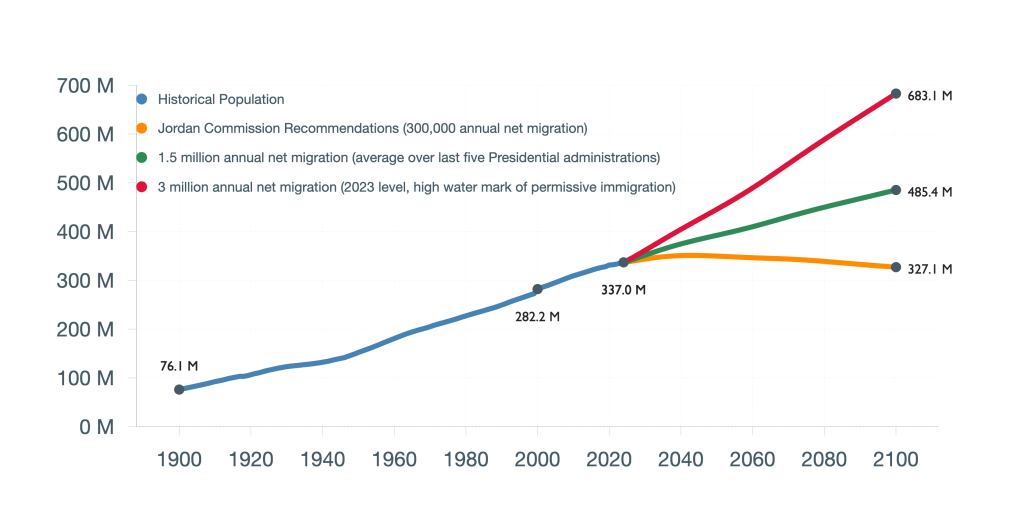
The U.S. population doubled during the past seventy years, from 170 million in 1955 to 340 million today. Because U.S. citizens have largely chosen to have small families, future immigration levels will determine whether our population stabilizes or continues to grow during this century. Continuing current immigration levels will increase our population by about 150 million more people by 2100.
Immigration policy is one of the few tools Congress directly controls that influences future demand for housing, infrastructure, water, and open space. If policymakers want conservation efforts to succeed over the long term, immigration policy should become part of America’s broader conservation strategy.
Not Your Members? | Create Account or Log In to manually enter your address.