Facebook
 Post
Post
 Email
Email
 Print
Print
The Farm Bill Addresses the Symptoms
Congress recently passed the Farm, Food, and National Security Act of 2026 (FFNS Act), a major new farm bill designed to expand land conservation efforts, improve agricultural resilience, and help preserve America’s remaining farmland.
Although the law attempts to slow farmland loss, Congress continues to avoid the primary force driving the problem: relentless outward development fueled by housing demand generated by persistently high levels of immigration.
The Real Threat Is Sprawl
In recent years, farmland preservation has become a growing national concern. Rural communities increasingly worry about the disappearance of productive farmland beneath subdivisions, warehouses, highways, power line corridors, and industrial development. Much of the public debate has focused on solar projects, zoning battles, and renewable energy siting.
Yet the real threat to American farmland is not solar panels at all. It is suburban and exurban sprawl. Reuters reported in 2024 that the USDA considers urban sprawl and development to be larger contributors to farmland loss than solar energy projects. Metropolitan regions continue expanding outward into agricultural areas because farmland at the suburban fringe is often the easiest and cheapest land to develop.
The scale of this land conversion is startling. Research from the American Farmland Trust estimates that from 2001 through 2016, the United States converted or paved over roughly 11 million acres of agricultural land. The organization projects that another 18.4 million acres could disappear by 2040 if current trends continue.
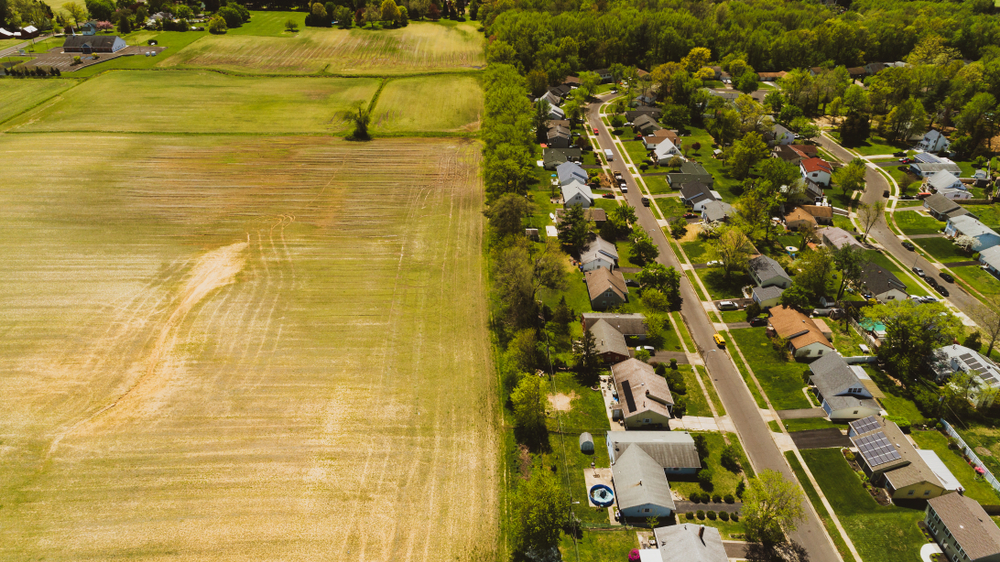
Housing development pushes against the edge of productive farmland. As population growth increases demand for housing, more agricultural land is converted to subdivisions, roads, and infrastructure—reducing the land available for food production.
Conservation Cannot Outrun This One Policy
The FFNS Act attempts to respond to America’s farmland crisis through expanded conservation tools and farmland protection initiatives. In doing so, the law acknowledges that preserving agricultural land is essential not only for farming itself, but also for food security, rural economies, water management, and long-term national resilience.
But meaningful farmland preservation ultimately requires addressing the forces that create demand for new development. As long as high immigration levels continue generating demand for additional housing, roads, schools, and infrastructure, pressure to convert agricultural land will persist.
Zoning restrictions, conservation easements, and preservation grants may slow land conversion temporarily, but rising housing demand steadily increases the financial incentives for farmland development. Over time, developers bid up agricultural land prices, roads expand outward, and utilities extend deeper into rural areas. Eventually, farmland preservation efforts are overwhelmed by the economic and political pressures created by continual growth.
Protecting farmland therefore requires more than preserving individual parcels. It also requires reducing the development pressure that high immigration levels continually push into rural landscapes and productive agricultural regions.
Immigration Must Be Part of the Conservation Debate
America cannot permanently protect agricultural land while simultaneously absorbing the housing demand generated by persistently high immigration levels. Farmland preservation is not simply a matter of conservation policy. It is also about ensuring that the land base supporting food production, water resources, and ecological stability is not steadily consumed by development pressures that could readily be moderated through changes in immigration policy.
Our nation already loses enormous amounts of farmland each year to expanding development. If policymakers are serious about preserving America’s agricultural land base, then immigration — now the primary driver of U.S. population growth — can no longer remain outside the national land-use.
Find the latest updates and actions on your Action Board.
Not Your Members? | Create Account or Log In to manually enter your address.