Facebook
 Post
Post
 Email
Email
 Print
Print
A new United Nations-backed report has delivered another warning about the state of the natural world. According to a 2026 update on migratory species, 49 percent of protected migratory populations are now declining, up from 44 percent just two years ago. Habitat loss and fragmentation were identified as among the greatest threats facing migratory wildlife worldwide.
Although the report is global in scope, the same warning signs are evident in the United States. Scientists estimate that North America has lost nearly 3 billion birds since 1970, while federal wildlife officials identify habitat loss and fragmentation as the leading threats to migratory birds. At the same time, mass immigration has become the primary source of U.S. population growth, driving demand for housing, infrastructure, and water that steadily consumes wildlife habitat.
Human Population Growth Leads to Habitat Loss
For migratory species, habitat loss is especially damaging because birds depend on a chain of habitats spread across hundreds or even thousands of miles. Breeding grounds, wintering areas, wetlands, and stopover sites must all remain functional. When any link in that chain is weakened, populations can suffer.
The causal chain is straightforward. More people require more housing. More housing requires more land, roads, utilities, and infrastructure. As development expands outward, forests, wetlands, grasslands, and farmland are converted to human uses. Large, connected habitats become smaller and increasingly fragmented, making it more difficult for migratory species to find food, shelter, and resting areas during their journeys.
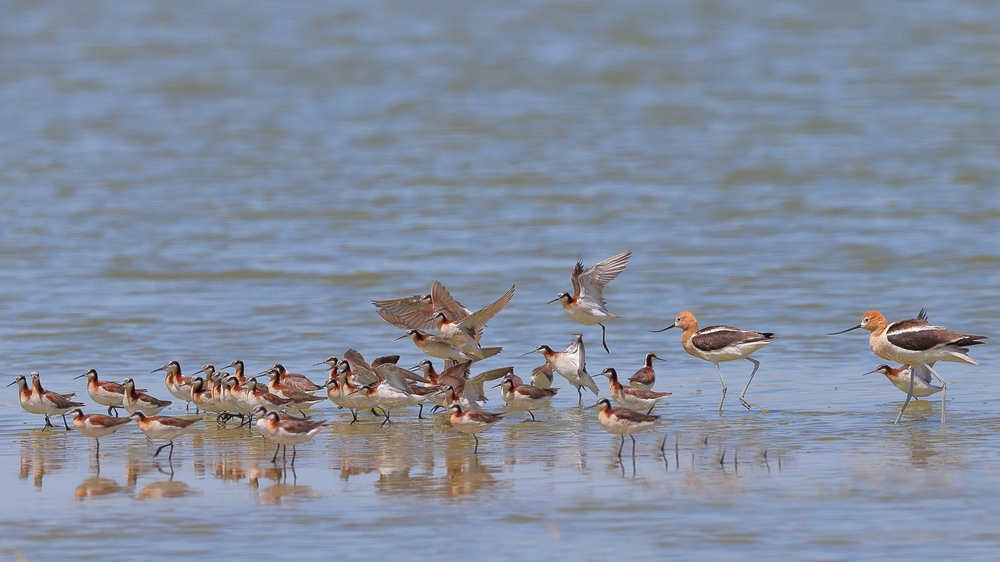
Wilson’s phalaropes flocking in shallow water. This species is closely tied to the Great Salt Lake. Recent findings estimate a 70% decline since 1980.
The Great Salt Lake Example
The Great Salt Lake provides one of the clearest American examples. The lake serves as one of the most important migratory bird stopovers in North America, supporting millions of waterfowl and shorebirds traveling the Pacific Flyway. Yet the lake has been shrinking as human population growth places increasing demands on limited water supplies. As more water is diverted to support homes, businesses, and development, less reaches the wetlands that migratory birds depend upon.
The same pattern can be found across the country. Housing demand follows population growth, and development follows housing demand. As new residents require homes, roads, utilities, schools, and commercial services, additional habitat is lost or fragmented. Migratory birds encounter these pressures throughout the Atlantic, Mississippi, Central, and Pacific flyways.
Conservation Requires Prevention
Conservation organizations have protected many important refuges, wetlands, and wildlife preserves, and those efforts remain valuable. But habitat protection cannot succeed indefinitely if habitat loss continues to outpace conservation. Preserving migratory birds requires more than protecting isolated parcels of land. It also requires addressing the forces that continue to convert habitat into development.
If habitat loss and fragmentation are primary causes of migratory bird decline, then policies that influence population growth deserve a place in the conservation discussion. Conservation efforts can help restore habitat after it has been damaged. But preserving migratory birds ultimately requires preventing habitat loss in the first place. Slowing immigration would reduce future demand for housing, land, water, roads, and infrastructure while helping preserve the large, connected landscapes that migratory birds need to survive.
Find the latest updates and actions on your Action Board.
Not Your Members? | Create Account or Log In to manually enter your address.